Confidential Documents You Should Destroy: A Guide for Australian Businesses
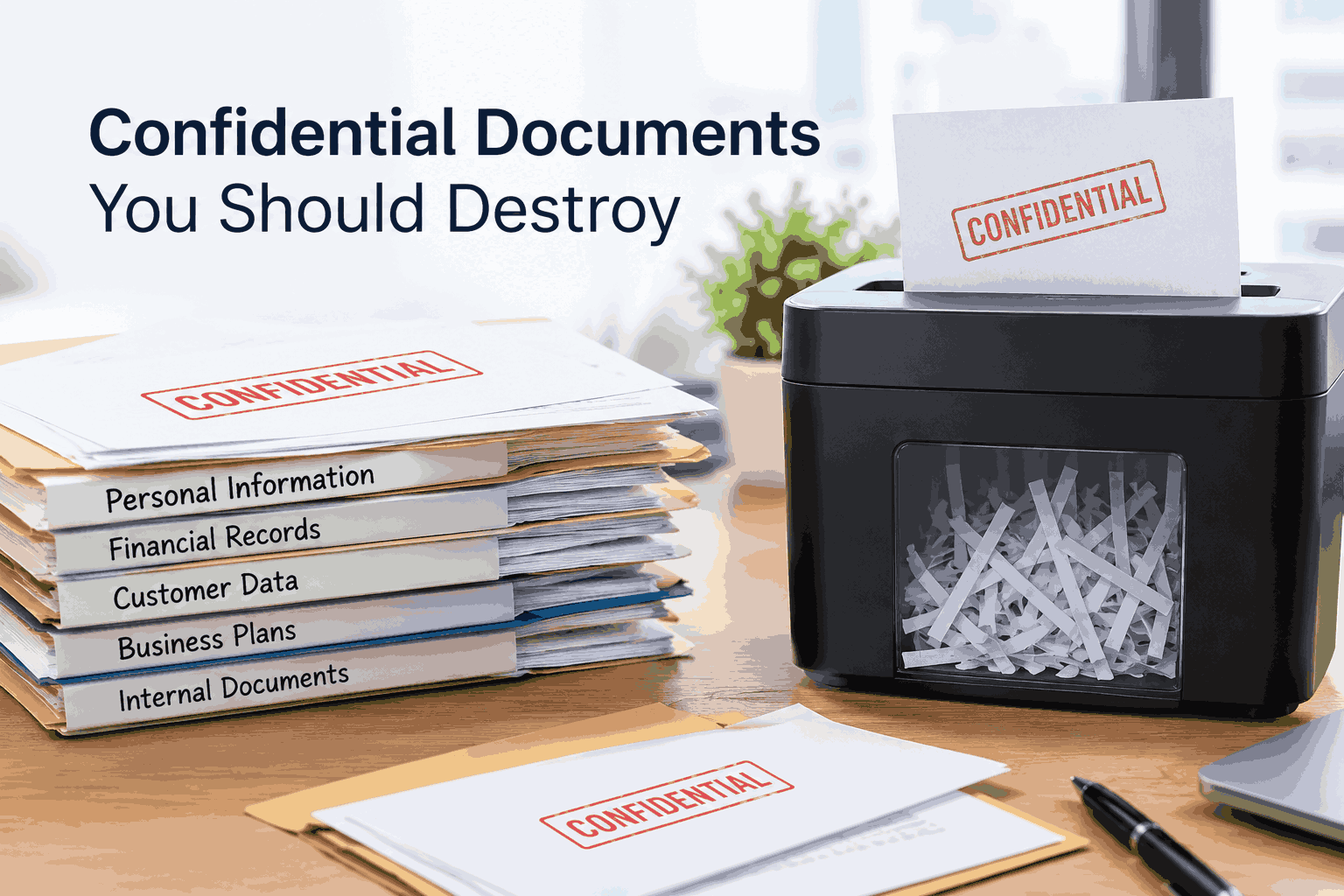
Confidential documents should not be left in a general waste or recycling bin.
Business records can contain customer details, employee information, financial data and sensitive company information. When these records are no longer needed, they should be securely destroyed.
The important part is knowing what should be destroyed and when.
Australian businesses also need to be careful about destroying records too early. Some documents must be kept for a set period under Australian e-waste laws.
In this guide, we look at the confidential documents businesses should destroy once they are no longer required. We also cover what to check before destroying them and how to manage the process safely.
In short
Businesses should securely destroy confidential documents that are no longer required.
These can include:
- Customer records
- Employee records
- Bank and financial documents
- Tax records after the required retention period
- Payment information
- Copies of identification documents
- Health information
- Old legal documents
- Supplier records
- Business strategy documents
- Product and design information
- Trade secrets
- Old printed emails and internal records
The first step is always to check whether the document still needs to be kept.
Why Should Businesses Destroy Confidential Documents?
Old documents can still create a security risk.
A document does not stop being sensitive just because it is sitting in an archive box. Someone who should not have access to it could still find it.
The OAIC says organisations covered by the Privacy Act need to take reasonable steps to protect personal information. This includes taking reasonable steps to destroy or de-identify information when it is no longer needed for a permitted purpose.
That makes secure document disposal part of good data management.
The risk can also grow when businesses keep large amounts of unnecessary information. More stored information means more information that could be exposed if there is a security incident.
What Confidential Documents Should You Destroy?
The right documents depend on what your business collects and how it operates.
The following records are common examples.
1. Customer Records
Customer records should be securely destroyed once they are no longer needed.
These records may contain names, addresses, phone numbers or other personal information. Some businesses may also hold financial details or copies of identification documents.
Old application forms can also contain more information than a business needs to keep.
Before disposal, check your retention requirements. Then use a secure destruction method rather than placing the papers in ordinary recycling.
2. Employee Records
Employee documents often contain highly personal information.
This can include payroll records, employment forms, performance reviews and disciplinary documents.
These records should be kept secure while they are required. They should then be disposed of properly when the retention period ends.
Fair Work requires employers to keep employee records for seven years. Employee records are also treated as private and confidential.
Do not assume an old employee file can simply be thrown away.
Check the retention requirement first.
3. Bank Statements and Financial Records
Financial documents can contain information that should never be available to unauthorised people.
Examples include:
- Bank statements
- Invoices
- Receipts
- Payment records
- Loan documents
- Financial reports
- Old accounting paperwork
Some financial records must be kept for a specific period.
For example, Australian companies generally need to keep financial records for at least seven years under the Corporations Act.
Once the required period has passed, unnecessary copies can be securely destroyed.
4. Tax Documents
Tax records need extra care because some must be retained for several years.
The ATO says most business records need to be kept for five years. Some records may need to be retained for longer depending on the circumstances.
That means businesses should not destroy tax documents simply because they are old.
Check the relevant retention period first.
Once the record is no longer required, destroy it securely.
5. Payment and Credit Card Information
Payment information deserves a high level of care.
Printed card details, payment records and other documents containing payment information should not be left where anyone can access them.
This can include old payment forms and printed transaction records.
Review whether the information still needs to be retained. Then use secure destruction for documents that are no longer required.
6. Copies of Identification Documents
Copies of identification documents can contain valuable personal information.
These may include copies of passports, driver’s licences or other identity documents collected during onboarding or verification.
A business may only need these documents for a specific purpose.
Once that purpose and any required retention period have ended, unnecessary copies should be securely destroyed.
It is also worth checking how many copies your business has.
You may have one in a digital system and another sitting in an old paper file.
7. Health and Medical Information
Health information needs careful handling.
Businesses may hold this type of information for employees, customers or clients. Medical records can contain details that could cause significant harm if exposed.
Do not place these records in ordinary rubbish or recycling.
The OAIC specifically notes that simply sending hard-copy personal information to garbage or recycling collection would not ordinarily amount to reasonable destruction unless the information has already been destroyed through a process such as shredding or pulping.
Retention requirements can vary between industries and jurisdictions.
Check those requirements before disposal.
8. Legal Documents
Legal documents can contain sensitive information long after a matter has finished.
Examples include:
- Legal correspondence
- Client documents
- Agreements
- Case-related records
- Settlement documents
- Internal legal advice
Some records may need to be retained for legal or business reasons.
Others may become unnecessary once the matter is closed and the relevant retention period has ended.
Do not destroy legal documents without first checking whether they are still required.
9. Supplier and Contractor Records
Supplier documents can contain more sensitive information than businesses expect.
These records may include contact details, payment information, contracts and commercial terms.
Old supplier files should be reviewed as part of a regular records management process.
Destroy unnecessary records once the relevant retention requirements have been met.
10. Business Strategy Documents
Not all confidential information is personal information.
A business can also have sensitive information that could harm the company if it reached a competitor.
Examples include:
- Business plans
- Pricing strategies
- Sales forecasts
- Expansion plans
- Internal reports
- Marketing plans
- Tender documents
These documents can have commercial value even after they are no longer current.
Old copies should be securely destroyed when they no longer serve a business purpose.
What About Product Designs and Research?
Product designs should be treated as confidential business information.
Technical drawings, prototypes, research notes and development documents can reveal how a product works or how it may be improved.
This information may give competitors useful insight.
The same applies to research and development records.
When these documents are no longer required, secure destruction can help prevent unwanted access.
What About Trade Secrets?
Trade secrets deserve particular attention.
A trade secret can include information that gives a business a commercial advantage.
Examples may include:
- Manufacturing processes
- Formulas
- Proprietary methods
- Internal systems
- Customer strategies
- Technical information
A document can still expose that information even after the project has ended.
Review old records regularly and destroy copies that are no longer needed.
What About Printed Emails and Internal Notes?
Printed emails are easy to overlook.
Someone may print an email for a meeting and leave it in a folder. An employee may print a customer request and forget about it later.
The same problem can happen with handwritten notes.
These papers may contain names, contact details, financial information or internal business information.
Do not assume that a document is safe because it was only printed for temporary use.
Include temporary records in your document disposal process.
Should You Destroy Every Old Confidential Document?
No.
A document should not be destroyed simply because it is confidential.
The first question should be whether you still need to keep it.
Australian privacy guidance makes this distinction clear. APP 11 requires covered organisations to take reasonable steps to destroy or de-identify personal information when it is no longer needed for a permitted purpose. There are exceptions where retention is required by law or a court or tribunal order.
Other record-keeping laws can also apply.
For example, companies generally need to retain certain financial records for at least seven years. Employers generally need to keep employee records for seven years. Most tax records need to be kept for five years.
So the goal is not to destroy records as quickly as possible.
The goal is to destroy records when they are no longer required.
How Should Confidential Documents Be Destroyed?
Confidential documents should be destroyed so the information cannot reasonably be retrieved.
Shredding is one common method for paper records.
The OAIC says hard-copy personal information sent to normal garbage or recycling collection would not ordinarily be considered securely destroyed unless the information has already been destroyed through an appropriate process.
That means putting confidential paperwork into a regular recycling bin is not a suitable solution for sensitive records.
A secure document destruction process can include:
- Separating confidential records from general paper waste
- Using secure collection containers
- Restricting access to stored documents
- Using controlled transport
- Destroying documents through an appropriate method
- Keeping records of the destruction
A documented process also makes it easier to show how sensitive information was handled.
What Is a Certificate of Destruction?
A certificate of destruction is a record showing that documents were destroyed.
It can help businesses maintain an audit trail.
The certificate may record details such as the date of destruction and the material that was destroyed. Some secure destruction providers offer this as part of their service.
A certificate does not replace your retention requirements.
You should still make sure the documents were eligible for destruction before sending them for disposal.
Can You Put Shredded Paper in Recycling?
Shredded paper may be recyclable.
The important question is what happens before the paper reaches the recycling stream.
Confidential information should be destroyed first.
The OAIC notes that paper containing personal information should be destroyed through an appropriate process such as shredding before being disposed of through ordinary waste or recycling channels.
This allows businesses to manage privacy and recycling as separate steps.
First, protect the information.
Then recover the material where possible.
What About Confidential Data on Computers?
Paper is only one part of the problem.
Many confidential documents now exist as electronic files. Those files may remain on laptops, desktops, hard drives and servers long after the equipment is no longer in use.
Deleting a file from a computer should therefore be treated differently from securely destroying the storage device.
The OAIC says reasonable steps for electronic personal information depend on the hardware involved. In some cases the hardware can be sanitised. In other cases the information may need to be irretrievably destroyed.
This is where document disposal connects with IT asset disposal.
When a computer reaches the end of its working life, businesses should consider both the equipment and the data stored on it.
How Can Businesses Create a Confidential Document Disposal Process?
A simple process can make document destruction much easier.
Step 1: Identify confidential documents
Start by finding out what types of sensitive documents your business handles.
Look at customer files. Review employee records. Check financial paperwork and internal business documents.
Step 2: Check retention requirements
Do not destroy records before the required retention period ends.
Check the relevant legislation and your industry requirements.
Step 3: Separate documents for destruction
Keep confidential material away from ordinary paper waste.
Use a dedicated process for documents that need secure destruction.
Step 4: Restrict access
Only authorised staff should handle documents waiting for destruction.
Secure storage can reduce the chance of information being viewed or removed before destruction.
Step 5: Destroy the documents securely
Use an appropriate destruction method for the sensitivity of the information.
For larger businesses, a professional destruction service can help manage collection and chain of custody.
Step 6: Keep a record
Document what was destroyed and when.
This creates a useful record for internal audits and information management.
Common Mistakes Businesses Make
Some document disposal mistakes happen because the process looks simple.
Putting confidential papers in the recycling bin
Regular recycling is not designed to protect sensitive information.
Keeping documents forever
Holding information indefinitely can create unnecessary privacy and security risks.
Destroying documents too early
Not every old document is ready for destruction.
Financial, tax and employee records may need to be retained for years.
Forgetting digital copies
Destroying a paper document does not remove the electronic copy.
Check shared drives, email systems and storage devices when reviewing old information.
Treating all documents the same
Not every document carries the same level of risk.
Sensitive personal information needs a stronger approach than ordinary business paperwork.
What Should Businesses Check Before Destroying Documents?
A quick review can prevent costly mistakes.
Ask these questions before disposal:
- Do we still need this document?
- Is there a legal retention requirement?
- Does it contain personal information?
- Does it contain commercially sensitive information?
- Are there digital copies?
- Is the document linked to an active dispute?
- Is it part of an audit or investigation?
- Can we prove when and how it was destroyed?
These questions can become part of your regular records management process.
Confidential Documents and IT Asset Disposal
Confidential information does not always sit inside a filing cabinet.
It can remain on an old laptop or desktop. It can also sit on a retired hard drive or server.
That creates a similar problem.
The hardware may be ready to leave the business. The data may still be accessible.
Businesses should therefore treat secure data destruction as part of their IT asset disposal process.
Cyber Recycling helps Australian businesses manage retired IT equipment through secure data destruction and responsible IT asset disposal. This can help protect information stored on end-of-life devices before the equipment moves into recycling or recovery.
What Should Australian Businesses Do With Old Confidential Documents?
Old confidential documents should be reviewed before disposal.
First check whether they still need to be retained.
Then separate the documents that are ready for destruction.
Paper records should be securely destroyed before they enter the normal recycling stream. Digital information needs an appropriate data destruction or sanitisation process. The OAIC recommends reasonable measures based on the type and sensitivity of the information involved.
The process does not need to be complicated.
It needs to be consistent.
Confidential Documents You Should Destroy: Conclusion
Confidential documents should not become a permanent part of your business records.
Customer files can become outdated. Employees leave. Projects finish. Old contracts expire. Business plans change.
Once a document is no longer required, secure destruction reduces the amount of sensitive information your business needs to manage.
The key is to destroy the right records at the right time.
Do not throw confidential paperwork into general recycling. Do not keep sensitive information forever. Do not forget about copies stored on computers and other devices.
A clear disposal process can help Australian businesses protect information throughout its lifecycle.
For electronic records stored on retired computers and IT equipment, Cyber Recycling provides secure data destruction and IT asset disposal solutions for Australian businesses.
 Copy Link
Other Blog

Data Protection Risks and How to Mitigate…
09-21-2026
How much data does your business have sitting on its systems right now? Think about customer details. Employee…

Secure Data Destruction: A Complete Guide for…
09-21-2026
Every business laptop, server, USB drive and phone that has ever held customer records or financial data becomes…
What Records Should Businesses Keep When Disposing…
08-20-2026
Australian businesses disposing of IT equipment must retain financial tax invoices, asset depreciation schedules, serialised Certificates of Data…