Secure Data Destruction: A Complete Guide for Australian Businesses

Every business laptop, server, USB drive and phone that has ever held customer records or financial data becomes a liability once it is no longer required.
Deleting a file does not remove it. It simply marks that space as available for future use.
Deleting a file, emptying the recycle bin, reformatting a drive, or disposing of a laptop in general waste does not destroy the data it contains.
For businesses, this is not merely a technical detail. It represents a genuine compliance and reputational risk.
This guide explains why proper destruction matters, the five methods businesses commonly use, and how to choose the right one.
Why Secure Data Destruction Matters
Businesses often treat data destruction services as a low priority, addressing it only when a device reaches the end of its working life.
In practice, any device that has ever stored sensitive data remains a security risk until that data is permanently destroyed, regardless of the size or industry of the business.
This includes retired mobile phones, decommissioned servers, photocopiers with internal storage, and USB drives no longer in active use.
In Australia, this is not simply best practice. It is a legal requirement.
The Privacy Act and the Australian Privacy Principles require businesses to properly destroy personal information once it is no longer needed.
Retaining customer or staff data beyond its useful life creates exposure to regulatory penalties, mandatory breach notifications, and lasting reputational damage.
The Five Methods Used by Businesses for Data Destruction
No single method is appropriate for every situation. The right approach depends on the type of device, the sensitivity of the data, and whether the hardware will be reused.
The following are the five methods most commonly applied.
1. Data Erasure (Software Wiping)
This involves a thorough overwrite of the storage medium, not a standard format.
Data erasure software overwrites every sector of a drive, often multiple times, in line with recognised standards such as NIST 800-88. This renders the original data unrecoverable while keeping the device fully functional.
Best suited to: Businesses intending to resell, donate or redeploy laptops and desktops while remaining compliant with privacy obligations.
Limitation: This method is not effective on physically damaged or failed drives, as the software cannot access sectors it cannot read.
2. Degaussing
Degaussing applies a powerful magnetic field to disrupt the data stored on magnetic media.
This achieves near-instantaneous destruction of data, even across very large volumes, and is accepted under certain high-security certification standards.
Best suited to: Organisations retiring large volumes of hard drives or magnetic tapes, particularly where speed and certainty of destruction are priorities.
Limitation: Degaussing is effective only on magnetic media such as hard drives and tapes, not solid-state drives. The equipment is costly, and the process also destroys the drive’s firmware, preventing any future reuse.
3. Physical Destruction (Shredding)
This method involves processing hard drives and other media through industrial shredding equipment.
It is widely regarded as the industry standard for hard drive destruction, reducing devices to fragments too small to reassemble or extract data from.
Best suited to: End-of-life drives, high-security environments, and organisations that require verifiable proof of destruction for audit purposes. This method also scales efficiently for large volumes of devices.
Limitation: Shredding is not always sufficient for solid-state drives unless the resulting fragments are sufficiently small, as SSDs store data differently from conventional hard drives.
4. Incineration
Less commonly used for standard IT equipment, incineration remains appropriate for highly sensitive material.
This process burns the media completely, leaving no recoverable data.
It is generally reserved for government, defence and other high-security applications where device reuse is not a consideration.
5. Crypto-Erasure
Where data has been encrypted from the outset, destroying the encryption key renders the data permanently unreadable, without requiring physical destruction of the device.
This method is efficient and well suited to cloud storage and encrypted volumes.
Its effectiveness depends entirely on the strength of the original encryption, and it is generally used in conjunction with another method for highly sensitive information.
Matching the Method to the Media
The following provides general guidance:
- Laptops and desktops intended for resale → Data erasure
- Large volumes of legacy drives or tapes → Degaussing or shredding
- SSDs, USB drives and mobile devices → Fine-particle shredding, rather than degaussing
- Highly classified material → Physical destruction or incineration
- Cloud accounts and encrypted volumes → Crypto-erasure, supported by documentation
Selecting the Right Method Is Not Enough — Documentation Is Essential
Many businesses complete the destruction process but fail to retain evidence of it.
In the event of an audit, or where a client requests confirmation, an assurance without documentation is not sufficient.
Businesses should engage a provider with recognised accreditation. Relevant standards include ISO 14001 (Environmental Management), ISO 45001 (Occupational Health & Safety Management), and AS/NZS 5377 (Management of E-Waste), independently assessed by a qualified auditor.
The destruction process itself should use certified erasure software, such as Blancco or WipeDrive, applying recognised standards like DoD 3-pass or 7-pass erasure.
Regardless of provider, businesses should always request a Certificate of Destruction or data erasure audit report, including device serial numbers and memory sizes. This document serves as formal proof of compliance should it be required by a regulator, client or insurer.
Establishing Sound Practice Within the Business
Several practices distinguish a genuinely compliant organisation from one operating without a clear process.
Establish a formal policy. This should address the complete data lifecycle, from creation through to destruction, with clearly defined protocols for each category of media.
Provide staff training. The effectiveness of any destruction policy depends on the consistency with which it is applied by employees.
Conduct regular audits. A policy should not be established and left unreviewed. Compliance should be verified on an ongoing basis.
Integrate destruction into asset lifecycle management, rather than treating it as an isolated task, to maintain consistent data security from acquisition through to disposal.
Consider sustainability alongside security. A shredded drive cannot be reused, whereas a securely wiped device often can, which may be a relevant factor in method selection.
Conclusion
Secure data destruction is not a matter of selecting the most forceful available method.
It requires matching the appropriate method to the device in question, obtaining documented proof of destruction, and embedding this process as standard business practice.
Businesses operating in North Territory and Western Australia can engage Cyber Recycling for certified data destruction services. We hold ISO 14001, ISO 45001 and AS/NZS 5377 accreditation, and provide a full audit report and Certificate of Destruction for every engagement.
Contact Cyber Recycling to discuss your organisation’s requirements.
 Copy Link
Other Blog
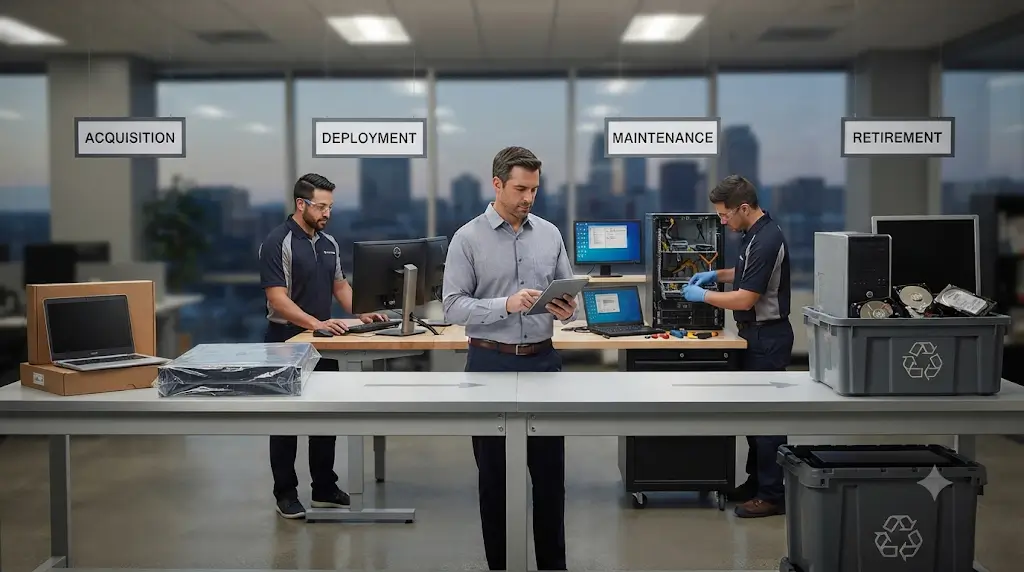
The 5 Stages of IT Asset Lifecycle…
11-19-2026
IT asset lifecycle management controls every IT asset from the moment a need is identified through to secure…

Why Your Business Needs an E-Waste Management…
11-19-2026
An e-waste management strategy is a documented plan for how an organisation stores, sanitises, reuses and recycles retired…
Lithium-Ion Battery Fire Hazards in the Workplace:…
11-17-2026
Lithium-ion battery fire hazards are highest when equipment is retired and placed in storage. Laptops, phones, power tools…