The Hidden ROI of IT Asset Recovery: Refurbishing vs. Recycling Corporate Hardware
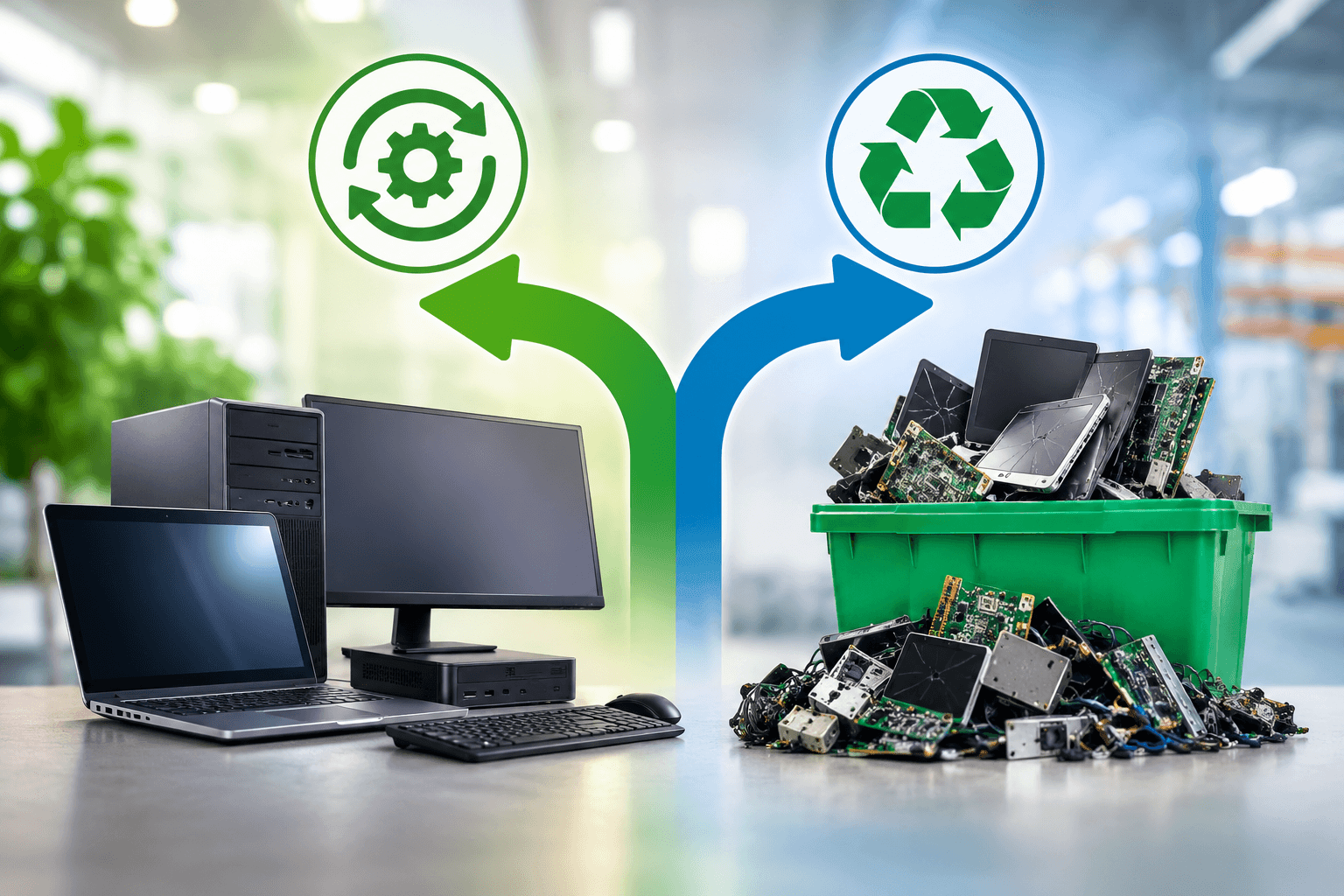
Most Australian organisations complete a hardware refresh without ever completing a hardware recovery.
Devices come off desks, a pallet is staged on the loading dock, and a collection is booked. In the finance system, that pallet carries no value. It was written down years earlier.
That valuation is rarely accurate, and the gap between book value and market value represents a measurable, recurring loss.
The decision between refurbishing vs. recycling corporate hardware is commonly treated as a logistics question: who collects the equipment, how quickly, and whether a certificate is issued. Framed that way, it defaults to recycling almost every time.
The distinction matters more than the framing suggests. Recycling recovers the materials within a device. Refurbishment recovers the device—along with the engineering, assembly, and freight already invested in it.
This article examines what each pathway returns, why depreciation schedules obscure the opportunity, how Western Australia’s landfill ban and the Northern Territory’s licensing regime alter the calculation in Perth and Darwin, and what Australian privacy obligations require before any asset is resold.
It concludes with a decision framework you can apply to your next refresh cycle.
Where Australian Organisations Lose Value on IT Disposal
Australia has both a volume problem and a value problem. The two compound one another.
The figures most often cited
Australia generated approximately 511,000 tonnes of e-waste in 2019. National projections place that figure near 657,000 tonnes by 2030 — an increase of almost 30 per cent within a decade (Clean Up Australia).
The per-capita comparison is less favourable still. The average Australian generates around 20 kg of e-waste annually, against a global average closer to 7 kg.
As of 2022, only about half of that volume was recycled, and roughly a third of the valuable material it contained was recovered (ABC News).
These are the figures that appear in sustainability reporting. They are not the figures that should drive a disposition decision.
The reason is straightforward in principle: they measure weight rather than worth.
A tonne of functional three-year-old laptops and a tonne of obsolete monitors are indistinguishable in a waste statistic. On a balance sheet, they have little in common.
The figure that is rarely cited
Industry analysis of the Australian and New Zealand market estimates an annual loss of approximately $430 million in hardware asset value, incurred by treating retired technology as waste rather than as capital.
The same research found that standard 36-to-48-month refresh schedules frequently fail to protect balance-sheet value. Devices held in storage after decommissioning can lose up to 80 per cent of their recovery value before a disposition decision is made (iTWire / Canopy).
This leads to an observation that most coverage of the topic overlooks.
The loss is seldom the result of a decision. It is the result of a delay.
Few organisations consciously elect to forfeit asset value. More commonly, disposition is deferred behind the deployment it follows, and remains deferred until the secondary market has moved a product generation.
Treating end-of-life IT equipment disposal as a scheduled event with a named owner and a deadline delivers a greater return than any negotiation over per-unit pricing.
Two questions that require separate answers
A second structural issue is less visible but equally costly.
“Is this device safe to release?” is a risk question.
“Does this device hold recoverable value?” is a financial question.
When the two are considered together, risk aversion tends to override the financial assessment, and the entire fleet is routed to destruction.
Assessed separately, most fleets divide cleanly. A substantial majority qualifies for refurbishment. A defined minority requires certified destruction.
That separation is not a relaxation of controls. It is the application of the correct control to the correct asset.
Refurbishing vs. Recycling Corporate Hardware: The Material Differences
Both pathways are legitimate, and both are necessary. They are not interchangeable.
The distinction is not one of degree. It concerns what remains at the end of the process.
What refurbishment involves
The process begins with irreversible data sanitisation. No assessment precedes it.
Subsequent stages include functional testing, economically justified component replacement, cosmetic reconditioning, grading against a published condition scale, and remarketing — either into the secondary market or back into internal deployment.
The device remains a device.
The assembly labour, refined materials and freight already invested in that unit remain in productive use rather than being returned to raw commodity form.
Grading warrants closer attention than it typically receives. A transparent grade accounts for chassis condition, screen defects, battery health cycles, keyboard wear and included accessories.
That assessment converts mixed hardware into a priced lot. Ungraded equipment is consistently purchased at the valuation of its weakest unit.
What recycling involves
Recycling is a materials process.
Devices are dismantled or shredded. Output streams are separated into ferrous and non-ferrous metals, plastics, glass and circuit board fractions, then supplied to refiners and manufacturers.
Hazardous components are isolated and managed under specific controls, with lithium batteries subject to the most stringent handling requirements.
Recycling recovers a proportion of the raw material and none of the manufacturing value.
For equipment that has reached genuine end of life, it is the correct and responsible pathway. Applied to serviceable equipment, it represents an avoidable write-off.
Where the waste hierarchy positions each pathway
Australian and international waste policy is explicit on sequence: avoid, reduce, reuse, recycle, recover energy, dispose.
Reuse is positioned above recycling deliberately.
The revised Australian Standard AS 5377:2022 — Management of electrical and electronic equipment for re-use or recycling — incorporates preparation for re-use directly within its scope, alongside collection, storage, transport and treatment.
The implication is clear. The national framework now anticipates that reuse will be assessed first, rather than treated as an optional addition.
This produces a practical reframing for procurement teams.
Refurbishing vs. recycling corporate hardware is not a choice between equivalent options. It is a hierarchy with a qualifying test. Refurbishment is the default position; recycling applies when a device does not qualify.
A provider who reverses that sequence warrants scrutiny. A per-tonne recycling rate quoted before any assessment of fleet age, model or condition reflects the provider’s logistics model rather than your recovery position.
The Return That Does Not Appear on the Balance Sheet
This is the point at which corporate hardware refurbishment ceases to be a sustainability matter and becomes a financial one.
Book value against market value
The Australian Taxation Office assigns portable computers, including laptops and tablets, an effective life of two years. General-purpose computers are assigned four (ATO depreciation tables).
Under the diminishing value method, a laptop reaches nil book value quickly.
The secondary market operates on a different timeline.
Well-maintained business-class laptops from tier-one manufacturers typically retain 15 to 30 per cent of original purchase price within the three-to-four-year window, with premium configurations at the upper end of that range.
By year five, retention falls to between 5 and 10 per cent — the threshold at which listing, freight and processing costs begin to absorb the remaining value.
Considered together, those two positions identify the opportunity.
The asset register records a device as worthless at approximately the point at which the secondary market values it most highly.
The accounting treatment is not incorrect. It answers a taxation question rather than a market question.
However, where disposition decisions are informed by the asset register, the organisation is structurally unable to see the only window in which value recovery is available.
That visibility gap, rather than vendor pricing, is the principal source of loss in most Australian IT asset recovery programs.
The cost of deferral
Age is the dominant determinant of recovery value — ahead of specification, brand and condition.
Value does not decline linearly. It steps down as each processor generation is released and as operating system support windows close.
A fleet processed within one quarter of decommissioning occupies a different pricing tier from the same fleet processed nine months later.
The arithmetic is unambiguous.
For 200 laptops carrying an average recoverable value of $180 at month zero, a nine-month deferral that halves that figure represents an $18,000 loss.
That exceeds the cost of operating a managed recovery program over the same period.
Storage is neither cost-free nor neutral. It constitutes a decision to sell later at a lower price, generally made by default rather than by analysis.
A worked example
Consider a Perth professional services firm retiring 200 laptops, 160 monitors and 40 docking stations after a four-year cycle.
| Pathway | Gross Recovery | Disposal Cost | Net Position |
|---|---|---|---|
| Recycle Entire Fleet | Nil to nominal scrap credit | Collection and processing fees | Net cost |
| Refurbish-First Triage | Resale across units that pass grading, plus scrap on the remainder | Collection, sanitisation, grading and remarketing | Net positive or cost-neutral |
Actual figures depend on model mix, condition and timing, which is why any credible provider assesses before quoting.
The structural conclusion holds regardless of the inputs. A refurbish-first triage converts a guaranteed cost centre into a potential contribution.
Cyber Recycling’s IT asset disposal and value recovery service follows that sequence: assess secondary market value, sanitise, then route the remainder to recycling.
Realised value is returned to the client after handling and refurbishment costs, with each unit logged by part and serial number in a certified asset report.
For an indicative figure ahead of a formal assessment, the e-waste calculator provides a reasonable starting point.
E-Waste Triage and Recovery Summary
| Device Profile | Recommended Pathway | Rationale |
|---|---|---|
| Business laptop, 2–4 years old, working and free of data restrictions | Refurbish and Remarket | Potential for strong residual value |
| Desktop or workstation, under 5 years old and working | Refurbish or Redeploy Internally | Can reduce new equipment procurement costs |
| Working monitors, docks and peripherals | Refurbish | Generally lower processing costs and potential resale demand |
| Server or network equipment under 6–8 years old | Assess Individually | Potentially high unit value and specialist resale market |
| Any device containing data subject to restricted handling requirements | Secure Data Destruction, Then Recycle | Must meet the organisation’s data security requirements before further handling |
| Failed motherboard, liquid damage or swollen battery | Recycle | Repair may exceed the equipment’s recoverable value; damaged batteries require appropriate handling |
| Equipment over 6–7 years old | Assess for Recycling | Often more suitable for component or material recovery, depending on condition and market demand |
Six Steps to an Effective IT Asset Recovery Program
Applying the framework requires operational structure. The following six steps convert the approach into recovered value.
- Schedule the disposition date alongside the deployment date.
When new hardware is ordered, the collection date for the retired fleet is set at the same time.
This single change in sequencing preserves more value than any other available intervention, because it eliminates the deferral described earlier.
It also addresses the most common internal objection — that disposition cannot be resourced immediately — by incorporating it into a project that already carries a budget and an owner.
- Capture serial numbers before equipment is moved.
An asset list compiled at the desk rather than at the dock enables a provider to pre-assess value and allows reconciliation between what was collected and what was certified.
Reconciliation after collection is where units are lost.
Export the list from an existing asset management or MDM platform rather than compiling it manually. The data generally exists already, and a stale register is itself a finding worth raising.
- Separate the risk decision from the financial decision in writing.
Have the security or compliance function classify device categories once, as policy.
Disposition then executes against that policy efficiently, rather than escalating case by case and defaulting to destruction as a precaution.
- Require named standards.
Which sanitisation standard is applied, and at what level? Which Australian standard governs handling? Where does treatment physically occur? What per-device documentation is provided?
Certification claims that cannot be answered specifically warrant further comparison.
- Consolidate collections, particularly in the Northern Territory.
Scheduled quarterly or project-based collections, appropriately packed and secured, outperform reactive pickups on both cost and condition.
Establishing a collection as a recurring calendar commitment rather than an ad-hoc request is a minor operational change with a measurable return.
- Report outcomes in both financial and environmental terms.
Value recovered and tonnes diverted. Reuse percentage and avoided embodied emissions.
One set of measures supports the finance function; the other supports sustainability disclosure. Both derive from the same per-serial asset report.
Programs reported on only one measure are consistently undervalued internally and difficult to re-fund. Managing disposition as a defined stage of IT asset lifecycle management is what makes the program repeatable.
Key Points
- Refurbishment preserves the device; recycling preserves only the materials. Refurbishing vs. recycling corporate hardware is a hierarchy with a qualifying test, and reuse sits above recycling in both Australian waste policy and AS 5377:2022.
- The asset register obscures the opportunity. The ATO assigns laptops a two-year effective life, while business-class machines retain 15–30 per cent of purchase price at three to four years. Book value and market value peak at opposite points.
- Deferral, not vendor pricing, is the principal source of loss. Idle devices can lose up to 80 per cent of recovery value, and ANZ organisations forfeit an estimated $430 million in hardware value annually.
- Data security governs the pathway and enables resale. NIST SP 800-88 Purge is the applicable standard. An MDM wipe does not constitute sanitisation and produces no evidence.
- Western Australian obligations changed in July 2024. The e-waste landfill ban established diversion as a regulatory baseline for significant entities. Refurbishment is the remaining lever for improved outcomes.
- Northern Territory freight economics penalise recycle-only defaults. Once a functional device is shredded in the Territory, the freight investment already made in it cannot be recovered.
- Emissions are concentrated in manufacturing, not electricity. Approximately 81 per cent of a laptop’s lifetime emissions are embodied before first use, making reuse the primary Scope 3 lever available under AASB S2.
Conclusion: Converting Retirement Into Return
The case for reassessing refurbishing vs. recycling corporate hardware does not rest on environmental considerations alone.
It rests on three propositions that can be verified within any organisation.
Finance systems write IT assets down more rapidly than the market does. The recovery window closes in months, not years. And in Western Australia, the compliance baseline has advanced beyond the point many disposal programs regard as their objective.
Recycling remains essential. Failed drives, damaged chassis, swollen batteries and restricted-classification media belong in a certified destruction and materials recovery stream without qualification.
Applied indiscriminately to a serviceable fleet, however, recycling is not a cautious position. It is an unbudgeted write-off repeated at every refresh cycle.
Organisations managing this effectively have made relatively few changes. They schedule collection when they schedule deployment. They classify device categories once as policy. They require named standards and per-serial documentation.
They also report outcomes in both financial and environmental terms, which is what secures funding for the following cycle.
For organisations planning a refresh in Perth or Darwin, the appropriate next step is an assessment rather than a quote.
Cyber Recycling has recovered value from Australian business hardware for 12+ years, handling approximately 340 tonnes annually across refurbishment, value recovery and certified recycling, with secure data deletion performed before any asset is resold.
Schedule a collection or contact the team to establish what your next decommissioning is worth.
The equipment holds value. The question is whether the organisation captures it or writes it off.
Frequently Asked Questions
Is refurbishing corporate hardware secure from a data perspective?
Yes, provided sanitisation precedes assessment.
Data is purged and verified before any device is evaluated for resale, using a method aligned to NIST SP 800-88 — typically cryptographic erase or verified overwrite, with physical destruction where verification fails.
Certified data sanitisation produces per-serial evidence suitable for audit. A remote wipe does not.
What is our retired IT equipment actually worth?
Age is the principal determinant.
Business-class laptops in the three-to-four-year window commonly retain 15–30 per cent of original purchase price. By year five that falls to 5–10 per cent, where processing and freight costs absorb the balance.
Specification, condition, battery health and model generation determine position within that range. A serialised assessment against current secondary-market pricing is the only reliable basis for a figure.
When should equipment be recycled rather than refurbished?
Recycle where the device fails the risk test, through restricted data classification or media that cannot be verifiably purged.
Recycle where repair cost exceeds residual value, including failed mainboards, screen damage, liquid ingress and swollen batteries.
Recycle where the device falls outside vendor and operating system support without a viable alternative.
In practice, this applies to a minority of a typical corporate fleet.
What does Western Australia’s e-waste landfill ban require?
The Waste Avoidance and Resource Recovery (e-waste) Regulations 2024 commenced on 1 July 2024 and prohibit disposal of regulated e-waste to landfill.
Obligations apply to e-waste service providers, landfill operators, and significant business and public entities.
For most Perth organisations this requires routing e-waste to a compliant provider. As diversion is now the baseline, refurbishment represents the available improvement.
Do different requirements apply in Darwin?
Yes. The Northern Territory has no equivalent landfill prohibition.
Waste handling operates under the Waste Management and Pollution Control Act 1998 (NT), with NT EPA licensing of waste handlers and facilities.
The more significant practical factor is logistics. Longer freight distances make consolidated, scheduled collections considerably more cost-effective than ad-hoc pickups, and make accurate triage at collection more consequential.
Does refurbishment support Scope 3 and AASB S2 reporting?
Directly.
Purchased IT hardware falls within Scope 3 purchased goods and services, and approximately 80 per cent of a laptop’s lifetime emissions are embodied in manufacturing.
Mandatory climate disclosure under AASB S2 commenced on 1 January 2025, with Scope 3 required from the second reporting period. Reuse rates and per-device reporting become auditable inputs to that disclosure.
What documentation should an ITAD provider supply?
At minimum: a serialised inventory captured at collection, chain-of-custody records for transport, and a certificate of data destruction referencing device serial numbers.
This should be accompanied by a statement of final disposition for each asset — refurbished, resold or recycled — and a settlement statement where value has been recovered.
Where any of these are unavailable, the program cannot be audited.
How long should retired equipment be held before a decision?
As briefly as practicable.
Retired hardware loses a substantial proportion of its recovery value while held in storage, and secondary-market pricing steps down with each processor generation and support-window closure.
Scheduling the disposition date alongside the deployment date is the most effective single change available to most organisations.
Can refurbished equipment be redeployed internally rather than sold?
Frequently, and it is often the highest-return option.
A four-year-old laptop no longer suited to a development role may be entirely adequate for reception, training rooms, kiosks, warehouse terminals or contractor loan pools.
Internal redeployment avoids a new procurement outright, which exceeds the return available from recovering a fraction of original purchase price on resale.
References
External sources
- Clean Up Australia — E-waste — Australian e-waste volumes, per-capita comparison and 2030 projections.
- ABC News — ‘Built-in obsolescence’ creates 500,000-tonne e-waste problem — national recycling and material recovery rates.
- Government of Western Australia, Department of Water and Environmental Regulation — E-waste to landfill ban in WA — Waste Avoidance and Resource Recovery (e-waste) Regulations 2024.
- National Institute of Standards and Technology — SP 800-88 Rev. 1, Guidelines for Media Sanitization — Clear, Purge and Destroy categories.
- Office of the Australian Information Commissioner — Notifiable Data Breaches statistics — notification volumes and causes.
- Australian Securities and Investments Commission — Sustainability reporting — mandatory climate disclosure and AASB S2.
- The Restart Project — The environmental impact of our devices — embodied carbon across 64 laptop models.
- Australian Taxation Office effective life tables — Depreciation of computers.
- iTWire — ANZ hardware recovery gap report — estimated annual value loss (industry research by Canopy).
- Standards Australia — AS 5377:2022, Management of electrical and electronic equipment for re-use or recycling.
 Copy Link
Other Blog

Data Protection Risks and How to Mitigate…
09-21-2026
How much data does your business have sitting on its systems right now? Think about customer details. Employee…

Secure Data Destruction: A Complete Guide for…
09-21-2026
Every business laptop, server, USB drive and phone that has ever held customer records or financial data becomes…
What Records Should Businesses Keep When Disposing…
08-20-2026
Australian businesses disposing of IT equipment must retain financial tax invoices, asset depreciation schedules, serialised Certificates of Data…