What Is the Difference Between E-Waste Recycling and IT Asset Disposal (ITAD)?

The primary difference between e-waste recycling and IT asset disposal (ITAD) is that e-waste recycling focuses on processing physical materials to protect the environment, whereas ITAD is an enterprise risk-management process designed to securely wipe data, comply with privacy laws, and recover financial value from retired hardware. While both services play a role in sustainable technology management, choosing the wrong service can leave your business exposed to severe data breaches, regulatory penalties, and lost financial returns.
Core Definitions: E-Waste Recycling vs. IT Asset Disposal
Understanding the distinction between material processing and corporate lifecycle management is essential for modern IT governance.
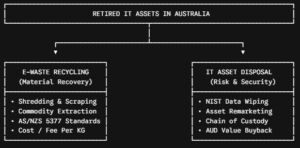
What Is E-Waste Recycling?
E-waste recycling is the process of collecting, dismantling, and shredding obsolete electronics to recover raw materials like copper, aluminium, gold, and plastics.
The primary objective of standard e-waste recycling is environmental sustainability and zero-landfill diversion. Equipment sent for basic e-waste recycling is treated as commodity scrap. While it ensures toxic substances such as lead and mercury do not enter Australian soil, standard e-waste recycling rarely offers certified data sanitisation, serialised inventory auditing, or financial returns for working hardware.
What Is IT Asset Disposal (ITAD)?
IT Asset Disposal (ITAD) is an enterprise strategy that manages the secure retirement of business hardware through certified data destruction, regulatory auditing, and maximum value recovery.
ITAD treats retired technology as active risk and potential financial assets rather than waste. Prior to physical recycling, ITAD providers perform NIST SP 800-88 Rev 1 data sanitisation, maintain a secure chain of custody, and test equipment for refurbishing and resale. ITAD ensures complete compliance with the Australian Privacy Act 1988 and guarantees that non-marketable components are responsibly recycled as a final step.
Head-to-Head Comparison: ITAD vs. E-Waste Recycling
Evaluating ITAD against e-waste recycling highlights stark differences in security, legal compliance, and financial outcomes.
| Operational Feature | E-Waste Recycling | IT Asset Disposal (ITAD) |
|---|---|---|
| Primary Goal | Environmental material recovery & scrap processing | Data risk mitigation, regulatory compliance & ROI |
| Data Sanitisation | Unverified or basic physical shredding | Certified NIST 800-88 / Degaussing / Cryptographic Erase |
| Australian Standard | AS/NZS 5377:2013 (E-waste collection) | AS/NZS 5377 + NAID AAA Certification |
| Chain of Custody | Minimal tracking; bulk weight receipts | Serialised GPS tracking, tamper-evident transport, full audit log |
| Documentation | Certificate of Recycling (Environmental) | Certificate of Destruction + Asset Audit Reports |
| Financial Outcome | Incurs transport & weight-based recycling fees | Generates revenue return via hardware buyback & remarketing |
| Target Hardware | Damaged cables, CRTs, broken monitors, scrap metal | Laptops, desktops, enterprise servers, SANs, smartphones |
The Data Security Divide: Why Basic Recycling Poses Legal Risks in Australia
Handing data-bearing hardware to a standard e-waste recycler without certified data wiping directly violates Australian Privacy laws. Standard recycling facilities crush and shred material in bulk, which can leave storage media like micro-SSDs and flash chips intact and recoverable before processing.
⚠️ LEGAL WARNING: PRIVACY ACT 1988 (CTH)
Under Australian Privacy Principle 11 (APP 11), Australian organisations are legally required to take reasonable steps to destroy or permanently de-identify personal information that is no longer needed. Handing active storage drives to an uncertified recycler exposes your business to Notifiable Data Breaches (NDB) and statutory fines exceeding $50 million for severe corporate breaches under recent amendments.
Certificates of Recycling vs. Certificates of Data Destruction
A Certificate of Recycling is an environmental compliance document, not proof of data destruction.
- Certificate of Recycling: Confirms that a specific weight of electronic scrap was processed in accordance with environmental standards (e.g., AS/NZS 5377). It provides zero legal protection if confidential customer data is subsequently extracted from an un-wiped hard drive.
- Certificate of Data Destruction (CoD): A legally defensible document detailing the exact serial number, media type, destruction method (NIST SP 800-88), and time stamp of every wiped or physically destroyed storage device. This document is mandatory for passing corporate data audits and demonstrating APP 11 compliance.
Financial Impact: Cost Centre vs. Revenue Recovery
Choosing ITAD turns hardware retirement from an operational expense into a value-generating strategy. Standard e-waste recyclers charge businesses per kilogram for pickup, handling, and material processing. In contrast, ITAD providers assess the resale value of corporate laptops, mobile devices, and servers.
Decision Framework: Which Service Does Your Business Need?
Selecting between ITAD and e-waste recycling depends entirely on asset type, data exposure, and hardware condition.
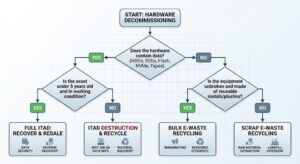
Choose ITAD If Your Hardware:
- Contains sensitive customer, financial, or employee data (laptops, servers, array drives, smartphones).
- Retains market resale value (typically manufactured within the last 3–5 years).
- Requires a serialised audit trail for regulatory compliance (APRA, OAIC, ISO 27001).
Choose E-Waste Recycling If Your Hardware:
- Contains zero storage media (cables, power supplies, server racks, broken keyboards, CRTs).
- Is physically damaged beyond repair or obsolete beyond secondary market demand.
- Has already undergone certified, verified NIST data sanitisation prior to collection.
Cyber Recycling Provided Recycling Solutions
Cyber Recycling provides comprehensive, Australian-compliant IT Asset Disposal and e-waste recycling services designed for modern enterprises. We protect your business from data liabilities while maximising the financial return on your retired technology assets.
Why Australian Businesses Partner with Cyber Recycling:
- Certified Data Security: We execute NIST SP 800-88 sanitisation and on-site physical destruction with serialised Certificates of Destruction.
- Maximised Value Recovery: Our global remarketing network ensures you get the highest AUD returns for viable hardware.
- 100% Australian Compliance: Full adherence to the Privacy Act 1988, AS/NZS 5377 standards, and state EPA regulations.
- Chain-of-Custody Tracking: End-to-end GPS-monitored transport and secure intake processing.
Protect your brand and unlock hidden value from your decommissioned hardware today.
Schedule Your Enterprise ITAD Audit with Cyber Recycling
 Copy Link
Other Blog

Data Protection Risks and How to Mitigate…
09-21-2026
How much data does your business have sitting on its systems right now? Think about customer details. Employee…

Secure Data Destruction: A Complete Guide for…
09-21-2026
Every business laptop, server, USB drive and phone that has ever held customer records or financial data becomes…
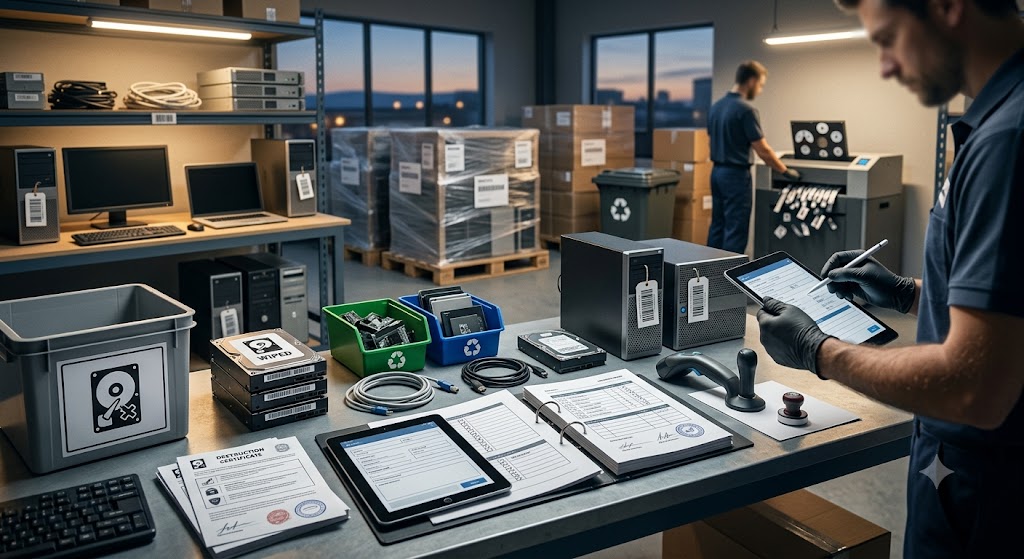
What Records Should Businesses Keep When Disposing…
08-20-2026
Australian businesses disposing of IT equipment must retain financial tax invoices, asset depreciation schedules, serialised Certificates of Data…