What Types of Business Electronics Can Be Recycled?
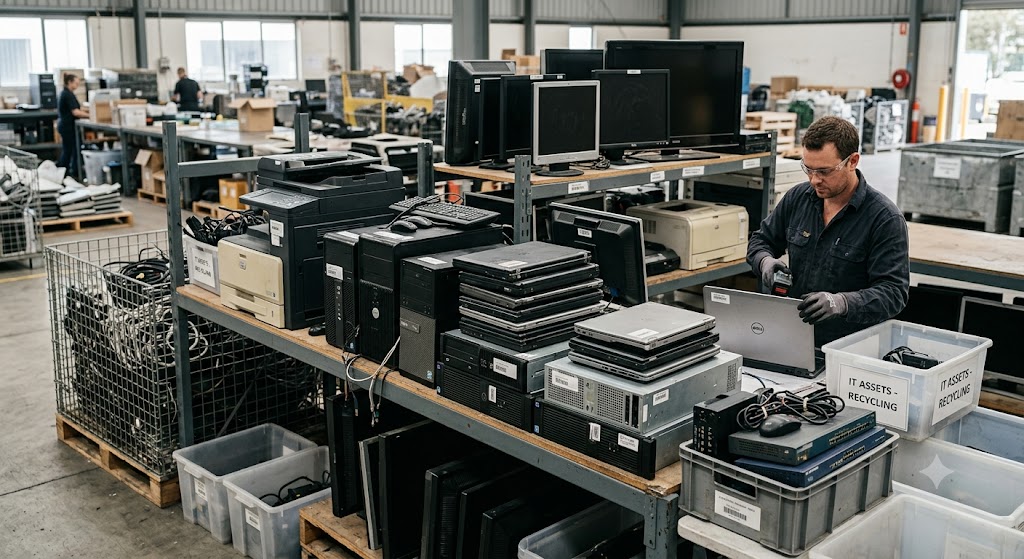
Australian businesses can recycle almost all commercial electronics, including computers, servers, monitors, networking gear, printers, mobile devices, uninterrupted power supplies (UPS), and office cables. Under Australian standards (AS/NZS 5377), these items are safely processed to recover valuable metals while protecting corporate data security.
Corporate Electronics Recycling Eligibility Matrix
Direct asset identification prevents costly landfill disposal fines and ensures full corporate compliance across all Australian states.
| Asset Category | Specific Electronics Recycled | Data-Bearing Status | Primary Processing Pathway |
|---|---|---|---|
| Computing Hardware | Laptops, desktop PCs, workstation towers, all-in-one PCs, tablets. | Yes (Requires NIST 800-88 sanitisation) | Component recovery, e-waste shredding, precious metal smelting. |
| Enterprise Servers | Rack servers, blade servers, mainframe units, SAN/NAS storage arrays. | Yes (High-security degaussing/shredding) | Gold, silver, copper, and palladium extraction; chassis steel recycling. |
| Networking Infrastructure | Enterprise routers, managed switches, patch panels, PABX systems, firewalls. | Yes (NVRAM & config wipe needed) | Board-level precious metal separation and plastics granulated. |
| Monitors & Displays | LCD/LED displays, commercial signage, interactive whiteboards, legacy CRTs. | No | Heavy glass, mercury, and plastic housing segregation. |
| Office Peripherals | Multi-function printers (MFPs), copiers, scanners, keyboards, mice, docking stations. | Conditional (Internal MFP hard drives) | Mechanical shredding, copper wire extraction, plastic recovery. |
| Power & Utilities | Enterprise UPS systems, power distribution units (PDUs), server room batteries, cabling. | No | Lead-acid/lithium battery recycling, heavy copper extraction. |
Computing Infrastructure & Server Room Equipment
Data centre decommissioning and IT refresh cycles demand specialised commercial disposal paths rather than basic municipal kerbside collections.
- Server Racks and Chassis: Cyber Recycling accepts complete server enclosures, rack units, and empty cabinet frames for full metal smelting and zero-landfill diversion.
- Storage Area Networks (SAN): High-density arrays, disk trays, and tape libraries undergo strict serialised tracking prior to physical destruction.
- Enterprise Routers & Switches: Core networking infrastructure, optical transceivers, and distribution switches are stripped for high-grade printed circuit board (PCB) recovery.
- Uninterruptible Power Supplies (UPS): Commercial battery backup systems are safely processed to isolate lead, lithium, and heavy metals in full compliance with Australian hazardous waste guidelines.
Office Peripherals, Mobile Devices, & Everyday Workstation Tech
Everyday office tech represents the highest volume of commercial e-waste generated by Australian businesses each year.
Workstation Electronics
- Laptops & Desktops: Bulk office fleets are completely stripped down, with all internal storage media isolated for certified destruction.
- Monitors & Interactive Displays: Flat-panel LED, LCD, and touchscreen monitors are processed using specialised shredding lines to prevent environmental leaching.
- Docking Stations & Power Adapters: Copper-rich cabling, power bricks, and desktop peripherals are granulate-processed for pure metal extraction.
Communications & Print Infrastructure
- Corporate Mobile Fleets: Smartphones, tablets, and mobile broadband devices are processed for rare-earth element recovery.
- Multi-Function Printers (MFPs): High-volume office printers contain hidden hard drives storing scanned files; Cyber Recycling isolates these hard drives before shredding the casing.
- PABX & IP Telephony: Office phone units, VoIP hardware, and central switchboards are recycled cleanly for high-value plastics and circuit elements.
Data Security & Legal Compliance Under Australian Law
Australian Privacy Principle 11 (APP 11) under the Privacy Act 1988 mandates that organisations take reasonable steps to destroy or de-identify personal information once it is no longer required. Failure to securely destroy data-bearing e-waste exposes your firm to massive regulatory fines and irreparable brand damage.
WARNING: Throwing corporate hard drives, SSDs, or photocopiers into standard skip bins or unaccredited recycling runs directly violates the Privacy Act 1988 and Australian Privacy Principles.
Corporate Data Destruction Checklist
- Serialised Asset Auditing: Record every serial number for hard drives, SSDs, and tape drives slated for disposal.
- Logical or Physical Sanitisation: Apply NIST SP 800-88 wiping standards or physical industrial shredding to render media permanently unreadable.
- Chain of Custody Tracking: Ensure locked, tamper-evident transport containers are used from your office to the processing facility.
- Certificate of Destruction: Obtain an official, legally binding Certificate of Destruction matching your asset audit log.
Australian State Legislation & Landfill Diversion Rules
E-waste is explicitly banned from landfills in several Australian jurisdictions, placing strict legal responsibility on commercial businesses to partner with certified recycling operators.
| State / Territory | Legal Status for Business E-Waste | Key Compliance Framework |
|---|---|---|
| Victoria (VIC) | Strict Ban: All e-waste is banned from landfill. | EPA Victoria Waste Framework (Environment Protection Act 2017). |
| South Australia (SA) | Strict Ban: All e-waste is banned from landfill. | Environment Protection (Waste to Resources) Policy. |
| Australian Capital Territory (ACT) | Strict Ban: Commercial electronics prohibited in landfill. | Waste Management and Resource Recovery Act. |
| New South Wales (NSW) | Restricted: High fines for improper disposal of hazardous tech. | NSW EPA Circular Economy Policy & Protection of the Environment Operations Act. |
| Queensland (QLD) | Restricted: Phased landfill diversion mandates active. | Waste Reduction and Recycling Act. |
| Western Australia (WA) | Restricted: Commercial e-waste bans expanding statewide. | WA Waste Avoidance and Resource Recovery Strategy. |
How Cyber Recycling Drives Australian Business Sustainability
Cyber Recycling delivers end-to-end, fully compliant commercial e-waste recycling for Australian businesses, government agencies, and enterprise facilities. Cyber Recycling handles everything from bulk collection logistics and chain-of-custody transport to AS/NZS 5377 compliant processing and NIST SP 800-88 data destruction. Every pickup includes serialised audit reporting and formal Certificates of Destruction to satisfy your legal compliance requirements under the Privacy Act 1988.
Ready to audit or clear your company’s end-of-life IT assets?
Contact Cyber Recycling today to book a certified commercial e-waste pickup for your business.
 Copy Link
Other Blog

Data Protection Risks and How to Mitigate…
09-21-2026
How much data does your business have sitting on its systems right now? Think about customer details. Employee…
Secure Data Destruction: A Complete Guide for…
09-21-2026
Every business laptop, server, USB drive and phone that has ever held customer records or financial data becomes…
What Records Should Businesses Keep When Disposing…
08-20-2026
Australian businesses disposing of IT equipment must retain financial tax invoices, asset depreciation schedules, serialised Certificates of Data…