On-Site vs. Off-Site Hard Drive Shredding: Which Option Is Safer?
Reviewed and Verified by Cyber Recycling Operations & Compliance Team: AS/NZS 5377, ISO 14001 & ISO 45001 Certified | NIST SP 800-88 Compliant Data Security Specialists
2026 Enterprise Market Context: The post-Windows 10 corporate device lifecycle refresh has triggered a massive turnover in enterprise hardware across Australia. Simultaneously, mandatory Scope 3 carbon reporting and strict Privacy Act enforcement ($50M+ penalties for data breaches) require organisations to verify both total data destruction and zero-landfill material recovery.
| Feature | On-Site Mobile Shredding | Off-Site Facility Shredding |
|---|---|---|
| Destruction Location | At your corporate premises via mobile shredding truck | High-capacity certified processing facility |
| Verification | Witnessed live by your IT security personnel | Recorded via video audit & GPS lockable bin tracking |
| Throughput | Up to 500 drives per hour | 2,000+ drives per hour |
| Media Capability | Magnetic HDDs & Solid State Drives (SSDs) to 2mm | Magnetic HDDs, SSDs, magnetic tapes, server blades |
| Chain-of-Custody Risk | Zero transport risk (destroyed prior to transit) | Mitigated via sealed lockable bins & serialised scan-in |
| Compliance Level | NAID AAA, APRA CPS 234, NIST SP 800-88 Rev 1 | NAID AAA, AS/NZS 5377, ISO 27001, NTCRS |
| Cost Profile | Higher base operational cost per drive | Lower unit cost for high-volume ITAD deployments |
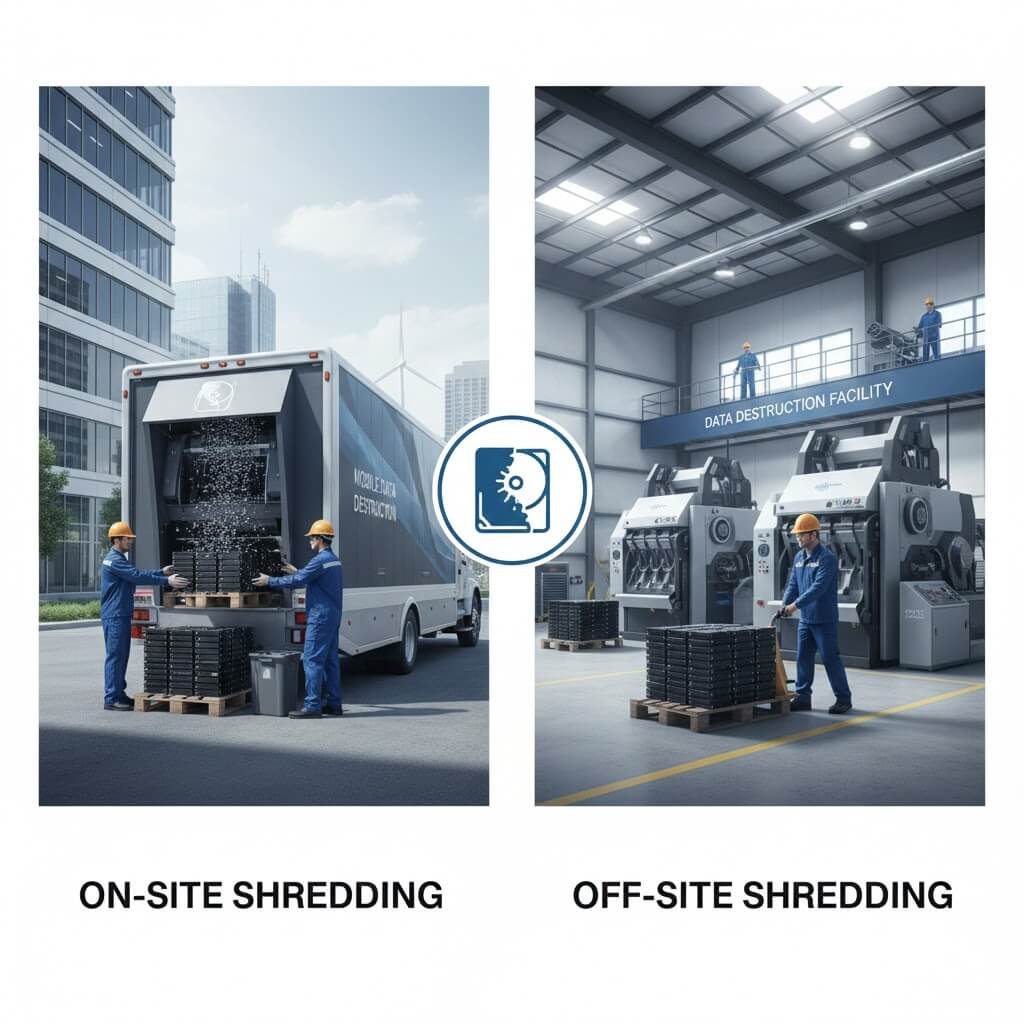
On-Site Mobile Hard Drive Shredding
Mobile data destruction units bring industrial-grade shredding technology directly to your facility. This service eliminates the risk of sensitive drives leaving your control unsanitised.
-
Live Witnessed Destruction: Your compliance or IT officers can visually verify the physical destruction of magnetic HDDs and solid-state drives (SSDs).
-
NIST SP 800-88 Rev 1 Compliance: On-site rotary shredders cross-cut media into micro-particles (down to 2mm for SSDs), rendering data recovery physically impossible.
-
Streamlined Regulatory Assurance: Meets immediate compliance demands for APRA CPS 234 regulated financial entities, defense contractors, and healthcare providers operating under the Australian Privacy Principles.
This option is optimal for corporate headquarters and government offices that mandate zero off-site transport of intact storage media.
Off-Site High-Volume Facility Destruction
Off-site shredding leverages centralised processing centres capable of handling enterprise-scale IT asset disposition (ITAD) projects efficiently.
-
Secure Chain-of-Custody Protocol: Drives are scanned by serial number, loaded into lockable, tamper-evident security bins, and transported in GPS-monitored vehicles.
-
Industrial E-Waste Processing: Facilities utilise high-torque shredders and multi-stage degaussing to process bulk server racks, tape drives, and storage arrays at scale.
-
Circular Economy Alignment: Shredded outputs undergo automated magnetic media separation to isolate aluminum, copper, rare-earth metals, and circuit boards for circular remanufacturing under the National Television and Computer Recycling Scheme (NTCRS).
Off-site processing offers a cost-effective solution for large-scale data center decommissionings and multi-site technology refreshes without sacrificing regulatory rigor.
Data Security Compliance and Chain of Custody
Physical media destruction must comply with statutory frameworks governing data privacy and environmental management.
-
Serialised Asset Tracking: Every HDD, SSD, or magnetic tape is scanned by serial number prior to destruction to create an immutable audit trail.
-
Landfill Ban Compliance: E-waste landfill bans enforced across Victoria, South Australia, Western Australia, and New South Wales make it illegal to dispose of electronics in general waste streams.
-
Audit Documentation: Upon completion, Cyber Recycling issues a Certificate of Destruction (CoD) confirming data sanitisation along with a Certificate of Recycling detailing Scope 3 carbon savings and material diversion rates.
Learn more about our core [Data Shredding Services], explore our end-to-end [Enterprise IT Asset Disposition (ITAD)], or review our sustainable [E-Waste Recycling Framework].
For regulatory reference, consult the DCCEEW National E-Waste Framework or view the current OAIC Privacy Act Enforcement Guidelines.
Local & Conversational FAQ Section
Q: What is the main security difference between on-site and off-site hard drive shredding?
A: The core security difference is the custody window. On-site shredding destroys drives at your physical location before transit, eliminating all transport risk. Off-site shredding secures drives in locked, GPS-tracked containers before transporting them to a certified processing facility. Both methods fulfil NIST SP 800-88 Rev 1 guidelines when backed by serialised asset tracking.
Q: Is commercial e-waste banned from landfill in Australia?
A: Yes. States including Victoria, South Australia, and Western Australia enforce strict e-waste landfill bans under environmental protection regulations. Commercial enterprises must dispose of hardware through accredited recyclers under AS/NZS 5377 standards to ensure zero-landfill processing and avoid regulatory fines.
Q: Does physical shredding satisfy NIST SP 800-88 Rev 1 data sanitisation standards?
A: Yes. Physical shredding satisfies NIST SP 800-88 Rev 1 standards for media destruction provided the particle size meets media-specific requirements (e.g., 2mm particle size for solid-state drives).
Q: What penalties do Australian businesses face for improper data disposal?
A: Under the Privacy Act 1988 (including recent enforcement updates), civil penalties for serious or repeated data breaches caused by improper asset disposal can reach up to $50 million, three times the value of any benefit obtained, or 30% of adjusted annual turnover.
 Copy Link
Other Blog

Data Protection Risks and How to Mitigate…
09-21-2026
How much data does your business have sitting on its systems right now? Think about customer details. Employee…

Secure Data Destruction: A Complete Guide for…
09-21-2026
Every business laptop, server, USB drive and phone that has ever held customer records or financial data becomes…
What Records Should Businesses Keep When Disposing…
08-20-2026
Australian businesses disposing of IT equipment must retain financial tax invoices, asset depreciation schedules, serialised Certificates of Data…