How to Recycle E-Waste | Complete Guide
Can You Put E-Waste in Regular Council Bins in Australia?
No. Placing electronic waste into your red landfill bin or yellow kerbside recycling bin is unsafe, damages municipal resource recovery facilities, and is illegal in several Australian states.
Yellow kerbside recycling bins are engineered solely to process paper, cardboard, rigid packaging plastics, glass bottles, and aluminium cans. Electrical items entangle conveyor sorting machinery, contaminate clean recycling streams, and present catastrophic safety risks to collection workers.
HAZARD WARNING: LITHIUM-ION BATTERY FIRES
Compacting electrical goods inside garbage collection trucks or sorting facilities can puncture embedded lithium-ion batteries. This causes thermal runaway, triggering intense chemical fires in waste trucks and processing facilities across Australia. Always remove batteries or deliver battery-containing devices to designated collection drop-off points.
State-Level Landfill Bans & Environmental Regulations
Australian state governments and Environmental Protection Authorities (EPAs) strictly regulate electronic waste disposal:
- Victoria (2019): EPA Victoria banned all e-waste from landfills. Placing any item with a cord, plug, or battery into household rubbish or recycling bins is illegal.
- South Australia (2013): Direct landfill bans apply to e-waste across metropolitan Adelaide and major regional waste zones.
- Australian Capital Territory (2021): ACT legislation prohibits e-waste from entering municipal waste streams, mandating diversion to resource recovery centres.
- Western Australia, New South Wales & Queensland: State EPAs enforce strict landfill diversion targets, and local municipal councils issue hefty fines for dumping electrical goods in domestic wheelie bins.
Free Household vs. Paid Commercial E-Waste Options in Australia
Navigating e-waste disposal depends on whether you are an individual householder dropping off a single device or a business managing bulk corporate hardware.
Free Community Stewardship Schemes (For Households & Small Quantities)
Government-backed product stewardship initiatives allow everyday householders to drop off specified consumer electronics at no charge.
- 1. National Television & Computer Recycling Scheme (NTCRS)
- Cost: Free
- Regulated By: Australian Federal Government (DCCEEW)
- Items Accepted: Televisions, desktop computers, laptops, monitors, printers, computer mice, keyboards, and external hard drives.
- Where to Go: Local council transfer stations, authorised collection hubs, and designated retail drop-off points.
- 2. MobileMuster
- Cost: Free
- Regulated By: Australian Mobile Telecommunications Association (AMTA)
- Items Accepted: Mobile phones, smartwatches, tablets, mobile broadband modems, chargers, cables, and accessories.
- Where to Go: Participating electronics stores, mobile phone carriers, and local public libraries.
- 3. B-cycle Scheme
- Cost: Free
- Regulated By: Battery Stewardship Council
- Items Accepted: Household batteries (AA, AAA, C, D, 9V, button cell) and removable power tool batteries.
- Where to Go: Dedicated collection units at participating national supermarket chains, hardware outlets, and municipal customer service centres.
- 4. Local Council Transfer Stations
- Cost: Free (for residents)
- Items Accepted: Small household kitchen appliances (kettles, toasters, blenders, vacuum cleaners, irons).
- Where to Go: Municipal resource recovery centres and council transfer stations.
Paid Commercial & Enterprise Disposal Options (For Businesses)
Public consumer drop-off bins have strict volume limits and cannot handle commercial server racks, office IT refreshes, industrial electronics, or devices requiring audited chain-of-custody documentation.
- Cyber Recycling Commercial ITAD & Data Security
- Cost: Paid / Custom Quote (Based on volume, site logistics, and security level)
- Services Provided: On-site transport logistics, bulk collection of office IT equipment, certified software data wiping, physical hard drive destruction, solar panel recycling, and ESG compliance reporting.
- Best For: Enterprise businesses, corporate offices, government departments, healthcare institutions, and organisations upgrading server or computer fleets.
- How to Book: Enquire directly via Cyber Recycling Australia.
Step-by-Step: How to Dispose of E-Waste by Category
Follow this quick guide to route your items through the correct Australian recycling pathways:
1. Computers, Laptops, Tablets & Mobile Devices
- Action: Back up your essential files to external drives or cloud storage, sign out of cloud accounts (Apple ID, Google, Microsoft), perform a factory reset, and remove SIM/memory cards.
- Where to Take Them: Households can drop devices at NTCRS or MobileMuster locations (including participating retail stores). Businesses requiring certified data destruction should contact Cyber Recycling for secure pickup.
2. Small Household & Kitchen Appliances
- Action: Unplug the device, bundle the power cord neatly, and clean out food debris or liquids (e.g., from blenders or coffee machines).
- Where to Take Them: Bring them to your municipal council transfer station or resource recovery centre. Do not place these in kerbside wheelie bins.
3. Loose Batteries, Power Cords & Chargers
- Action: For loose lithium-ion batteries, place clear sticky tape or electrical tape over the terminals to prevent short-circuiting and fire risks during transport.
- Where to Take Them: Drop batteries into B-cycle bins at major supermarkets or hardware outlets. Loose cords and chargers can be recycled at MobileMuster drop points or council small e-waste bins.
4. Large Whitegoods, Commercial IT & Solar Panels
- Action for Residential Whitegoods: Book a municipal kerbside hard waste collection (most councils offer 1 to 2 free booked collections yearly) or haul them to a council transfer station.
- Action for Commercial IT & Solar Systems: Public consumer drop-offs cannot accept commercial electronics or solar panel arrays. Facilities like Cyber Recycling provide specialised commercial collection, solar panel recovery, and business asset decommissioning across Australia.
State-by-State E-Waste Rules & Local Drop-Off Finders
Regulations and collection networks vary depending on your state or territory. Use these authorised state resources and facility hubs:
NATIONAL FINDER TOOL: Planet Ark’s “Recycling Near You”
For instant local drop-off mapping across every Australian postcode, visit recyclingnearyou.com.au or contact your local municipal council.
- New South Wales (NSW): Access the NSW EPA Community Recycling Centre (CRC) network for free household e-waste and battery drop-offs.
- Victoria (VIC): Refer to Sustainability Victoria and municipal transfer stations operating under the state’s total landfill ban.
- Western Australia (WA): Check WA Waste Authority guidelines for household drop-off sites. For commercial e-waste recycling, server decommissioning, and corporate ITAD in Perth, Cyber Recycling Australia operates a local facility offering certified drop-off and bulk business pickup options across metropolitan WA.
- Queensland (QLD): Major councils (e.g., Brisbane City Council, Gold Coast City Council) host free drop-offs at Resource Recovery Centres.
- South Australia (SA): Utilise local council drop-off depots and state-wide e-waste collection initiatives operating under SA’s landfill ban.
- Australian Capital Territory (ACT): Access the ACT Recyclopaedia for drop-off locations at Mugga Lane or Mitchell Resource Management Centres.
- Northern Territory (NT): Municipal transfer stations in Darwin and Alice Springs accept household items. For enterprise data destruction, commercial solar panel recycling, and business ITAD in Darwin, Cyber Recycling maintains a facility in Berrimah servicing corporate and government clients across top-end NT.
- Tasmania (TAS): Major municipal hubs in Hobart and Launceston maintain permanent e-waste collection bays under the NTCRS program.
How to Wipe Personal & Business Data Before Recycling
Prior to surrendering any digital storage device, ensuring complete data destruction is vital for privacy protection and legal compliance under the Privacy Act 1988 (Cth).
DIY Consumer Data Sanitisation Checklist
- Back Up Important Files: Transfer photos, financial records, and credentials to a cloud account or external storage drive.
- Sign Out of Accounts: De-authorise DRM software, remove device management profiles, and sign out of Apple ID, Google, and Microsoft accounts.
- Perform Factory Reset:
- Windows: Settings > System > Recovery > Reset this PC (select “Remove Everything and Clean Drive”).
- macOS: System Settings > General > Transfer or Reset > Erase All Content and Settings.
- iOS / Android: Settings > General / System > Reset > Erase All Content and Settings.
- Remove Memory Cards: Eject micro-SD cards and mobile SIM cards before dropping off your hardware.
FOR AUSTRALIAN BUSINESSES & ORGANISATIONS
For enterprise IT hardware, standard factory resets do not satisfy statutory privacy compliance.
Cyber Recycling provides certified, audit-ready data destruction software sanitisation and physical hard drive shredding, issuing formal Certificates of Data Destruction for full compliance with Australian Privacy Principles (APPs).
Book Commercial Data Destruction with Cyber Recycling
How E-Waste Is Processed: What Happens After Drop-Off?
Recycling converts obsolete electronic devices back into raw manufacturing materials, keeping toxic substances out of Australian soil and waterways.
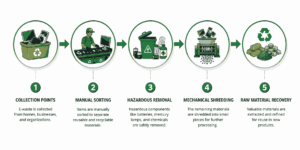
- Collection Points: Electronics are gathered via municipal depots, retail bins, or commercial ITAD pickups.
- Manual Sorting: Technicians categorise devices by type, assessing units for potential refurbishment or disassembly.
- Hazardous Removal: Trained workers manually extract dangerous components, including lithium-ion batteries, mercury lighting, and lead glass.
- Mechanical Shredding: Industrial shredders reduce remaining clean equipment into small fragments under 20mm.
- Raw Material Recovery: Magnetic separators pull out steel, eddy-current systems extract aluminium and copper, and optical sorters separate plastics. Refined metals re-enter the circular manufacturing supply chain.
How Australian Businesses Can Minimise & Manage E-Waste
Preventing unnecessary e-waste generation is just as important as recycling. Australian companies can adopt circular economy practices to reduce environmental footprints and lower procurement costs:
- Repair & Upgrade First: Upgrade internal RAM or SSD storage instead of replacing functional laptop fleets.
- Procure Modular Hardware: Choose IT suppliers offering modular designs, long manufacturer warranties, and easily replaceable components.
- Implement Asset Value Recovery: Partner with ITAD providers like Cyber Recycling to test, refurbish, and remarket viable corporate hardware, converting decommissioned equipment into financial returns.
- Track ESG Sustainability Metrics: Maintain formal records of recycled hardware to generate carbon offset data for corporate sustainability reporting.
Commercial E-Waste Recycling & ITAD Services by Cyber Recycling
While households use free community collection points, Australian companies, government bodies, and commercial operations require formal chain-of-custody tracking, asset reporting, and certified security.
Cyber Recycling provides specialised business-to-business IT Asset Disposal (ITAD) solutions across Australia:
- Commercial E-Waste Recycling: Responsible processing of office computers, server racks, networking infrastructure, printers, and industrial electronics.
- Certified Data Destruction: NIST SP 800-88 compliant software wiping and physical hard drive shredding with issued Certificates of Destruction.
- Solar Panel & Battery Recycling: Specialised recycling programs for decommissioned commercial solar systems and industrial battery banks.
- Operational Facilities in Perth & Darwin: Local processing hubs delivering fast, compliant services for businesses across Western Australia and the Northern Territory, alongside nationwide logistics capabilities.
Frequently Asked Questions
Is e-waste drop-off free in Australia?
Yes, dropping off personal televisions, computers, laptops, mobile phones, tablets, and household batteries is completely free for householders at authorised NTCRS, MobileMuster, and B-cycle drop-off points or council transfer stations.
Can I donate working electronics instead of recycling them?
Yes. If your old devices are in working condition, consider donating them to local charities, community groups, or school programs. Ensure you check with the organisation first and perform a complete data reset before donating.
What should I do with swollen or damaged lithium batteries?
Never place swollen, leaking, or damaged batteries into standard retail bins or kerbside trash. Isolate the battery in a clear plastic or glass container, tape the terminals with non-conductive electrical tape, and contact your local council hazardous waste facility immediately.
Are whitegoods like fridges and washing machines included in national e-waste schemes?
No, large whitegoods are not covered under the free NTCRS program. However, most local municipal councils offer scheduled kerbside hard waste collections or accept whitegoods at local transfer stations.
Why can’t electrical items go into yellow kerbside recycling bins?
Yellow kerbside bins are designed exclusively for packaging materials like paper, cardboard, glass, cans, and rigid plastics. Electrical items entangle machinery at Materials Recovery Facilities (MRFs) and pose extreme fire risks due to embedded batteries.
Partner with Cyber Recycling for Safe, Compliant E-Waste Solutions
Whether you need to clear out obsolete office computers, decommission server infrastructure, or ensure 100% compliant data destruction, Cyber Recycling delivers certified, eco-friendly solutions tailored for Australian organisations.
- Perth Facility (WA): Serving metropolitan Perth and regional Western Australia.
- Darwin Facility (NT): Serving corporate, industrial, and government clients across the Northern Territory.
- National Service Network: Complete B2B pickup and ITAD coverage across Australia.
Ready to recycle your commercial e-waste? Contact the team at Cyber Recycling Australia today to request a commercial collection quote and compliance consultation.
 Copy Link
Other Blog

Data Protection Risks and How to Mitigate…
09-21-2026
How much data does your business have sitting on its systems right now? Think about customer details. Employee…
Secure Data Destruction: A Complete Guide for…
09-21-2026
Every business laptop, server, USB drive and phone that has ever held customer records or financial data becomes…
What Records Should Businesses Keep When Disposing…
08-20-2026
Australian businesses disposing of IT equipment must retain financial tax invoices, asset depreciation schedules, serialised Certificates of Data…