What Records Should Businesses Keep When Disposing of IT Equipment?
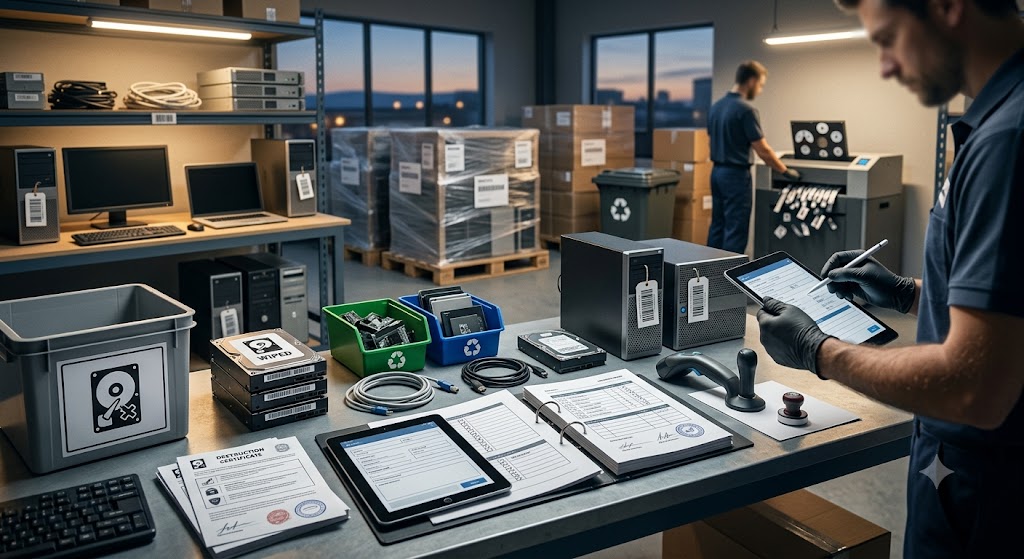
Australian businesses disposing of IT equipment must retain financial tax invoices, asset depreciation schedules, serialised Certificates of Data Destruction, and environmental transfer manifests to remain fully compliant with Australian Taxation Office (ATO) regulations and the Privacy Act 1988. Proper documentation protects your business against ATO tax penalties, costly data breach liabilities, and environmental compliance audits.
The Three Pillars of IT Disposal Record Keeping in Australia
Maintaining complete audit trails requires addressing three distinct areas of Australian corporate law.
Pillar 1: ATO Financial & Tax Records (Tax Compliance)
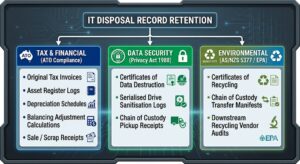
The Australian Taxation Office requires businesses to retain all documentation related to the acquisition, depreciation, and disposal of IT equipment to substantiate tax deductions and asset write-offs. Failing to maintain these financial records can lead to administrative penalties and disallowed tax deductions during an ATO audit.
Essential ATO Tax Records to Retain:
- Original Purchase Invoices: Demonstrate the first element of cost, including initial acquisition price and GST paid.
- Asset Register & Depreciation Schedules: Document the opening adjustable value, effective life calculations, and annual depreciation claims.
- Proof of Disposal / Sale Receipt: Documents the termination value, whether sold for scrap, remarketed, or traded in.
- Balancing Adjustment Calculations: Records showing the difference between the asset’s termination value and its adjustable value at the time of disposal.
How Long Must You Keep ATO Asset Disposal Records?
ATO regulations mandate that you must keep records for depreciating IT assets for five years after you dispose of the asset.
A common misconception is that records only need to be kept for five years from the initial purchase date. For depreciating hardware, the five-year retention period begins on the date you lodge your tax return for the income year in which the asset was sold, scrapped, or written off.
Example: If your business purchased a server in 2021, depreciated it over four years, and disposed of it in September 2025, you must retain all original purchase and disposal records until at least October 2031 (five years post-tax lodgement for FY26).
Pillar 2: Data Security & Privacy Records (Legal Compliance)
The Three Pillars of IT Disposal Record Keeping in Australia: Retaining verified data destruction documentation is your only legal protection if decommissioned hardware is later involved in a data breach investigation.
⚠️ LEGAL WARNING: OAIC DATA BREACH PENALTIES
Disposing of data-bearing IT assets without verified, serialised data destruction records exposes your organisation to severe regulatory enforcement under the Privacy Act 1988 (Cth). Failure to ensure permanent data destruction can trigger Notifiable Data Breach (NDB) reporting obligations and corporate fines exceeding $50 million for serious or repeated privacy interferences.
Essential Fields Required on a Certificate of Data Destruction
A generic recycling receipt does not constitute legal proof of data destruction under Australian law. A valid Certificate of Data Destruction must contain the following serialised information:
- Unique Certificate Serial Number: For official registry and tracking purposes.
- Date and Location of Destruction: Exact timestamp and facility address where wiping or shredding occurred.
- Serialised Asset Inventory: Individual serial numbers of every hard drive, SSD, array drive, or device processed.
- Sanitisation Method Used: Explicit reference to recognised standards such as NIST SP 800-88 Rev 1 (Clear, Purge, or Destroy) or physical shredding size.
- Software / Hardware Tools Applied: Name and version of wiping software or degaussing/shredding equipment used.
- Verification Status: Explicit confirmation that 100% of sector passes were successfully verified or drives were destroyed.
- Sign-Off by Certified Technician: Signature, name, and accreditation details of the operator managing the process.
Pillar 3: Environmental & Chain of Custody Records (ESG Compliance)
Environmental regulations and state EPA frameworks mandate that commercial e-waste must be diverted from Australian landfills and directed to accredited recyclers. Maintaining environmental records validates your company’s corporate sustainability governance and satisfies ESG audit criteria.
Essential Environmental Records to Retain:
- Chain-of-Custody Pickup Receipts: Signed transfer manifests confirming secure pickup by a licensed transport provider.
- Certificates of Recycling: Official documentation verifying that non-marketable equipment was processed under AS/NZS 5377:2013 standards.
- Material Recovery Breakdown Reports: Weight-based logs detailing recovered metals, plastics, and circuit boards for corporate carbon and waste reduction reporting.
Master Checklist: IT Asset Disposal Record Retention Summary
This quick-reference master checklist outlines the required retention periods and legal drivers for every IT disposal record type.
| Document Name | Primary Purpose | Required Retention Period | Governing Body / Standard |
|---|---|---|---|
| Tax Invoices & Purchase Orders | Substantiating asset acquisition cost | 5 Years Post-Disposal Lodgement | Australian Taxation Office (ATO) |
| Depreciation Schedules | Documenting tax deductions claimed | 5 Years Post-Disposal Lodgement | Australian Taxation Office (ATO) |
| Proof of Sale / Scrap Receipt | Calculating balancing adjustments | 5 Years Post-Disposal Lodgement | Australian Taxation Office (ATO) |
| Certificate of Data Destruction | Proving permanent data destruction | Permanent / Min. 7 Years | OAIC / Privacy Act 1988 (APP 11) |
| Serialised Asset Audit Log | Individual device tracking | Permanent / Min. 7 Years | NAID AAA / NIST SP 800-88 |
| Certificate of Recycling | Verifying environmental processing | 5 Years | State EPAs / AS/NZS 5377 |
| Chain-of-Custody Manifest | Confirming secure transport transfer | 5 Years | ISO 27001 / Internal Audit |
Cyber Recycling Enterprise Solutions
Cyber Recycling provides end-to-end commercial e-waste recycling and IT asset disposal services equipped with automated, audit-ready compliance reporting. We eliminate compliance risks by delivering fully integrated financial, security, and environmental records for every piece of retired technology.
Why Australian Businesses Partner with Cyber Recycling:
- Automated Audit Reporting: Receive detailed, serialised Certificates of Data Destruction and AS/NZS 5377 recycling manifests instantly after processing.
- NIST-Compliant Sanitisation: Complete data wiping and physical shredding protocols aligned with NIST SP 800-88 standards and Privacy Act mandates.
- 100% Australian Compliance: Full coverage for ATO asset tracking requirements, OAIC privacy guidelines, and state EPA recycling regulations.
- Secure Chain of Custody: Lockable security bins, GPS-tracked vehicles, and site-to-facility inventory control across Australia.
Simplify your IT equipment disposal and ensure total regulatory compliance today.
Schedule Your Business E-Waste Pickup with Cyber Recycling
 Copy Link
Other Blog
The 5 Stages of IT Asset Lifecycle…
11-19-2026
IT asset lifecycle management controls every IT asset from the moment a need is identified through to secure…

Why Your Business Needs an E-Waste Management…
11-19-2026
An e-waste management strategy is a documented plan for how an organisation stores, sanitises, reuses and recycles retired…
Lithium-Ion Battery Fire Hazards in the Workplace:…
11-17-2026
Lithium-ion battery fire hazards are highest when equipment is retired and placed in storage. Laptops, phones, power tools…